The Stevenson Screen
Louvred wood, white paint, a specified height: the point is to measure air rather than sunshine, and the design has barely changed.
A box that keeps the sun out
The temperature on your morning forecast did not come from a thermometer sitting in the sun. It came from a thermometer inside a white wooden box, mounted on legs, with louvred walls that let air pass freely while blocking direct radiation and rain. That box has a name — the Stevenson screen — and its design has barely changed since the 1860s. The fact that measurements made in Edinburgh in 1870 are comparable with measurements made in Nairobi today owes a great deal to how obstinately its specification has resisted improvement.
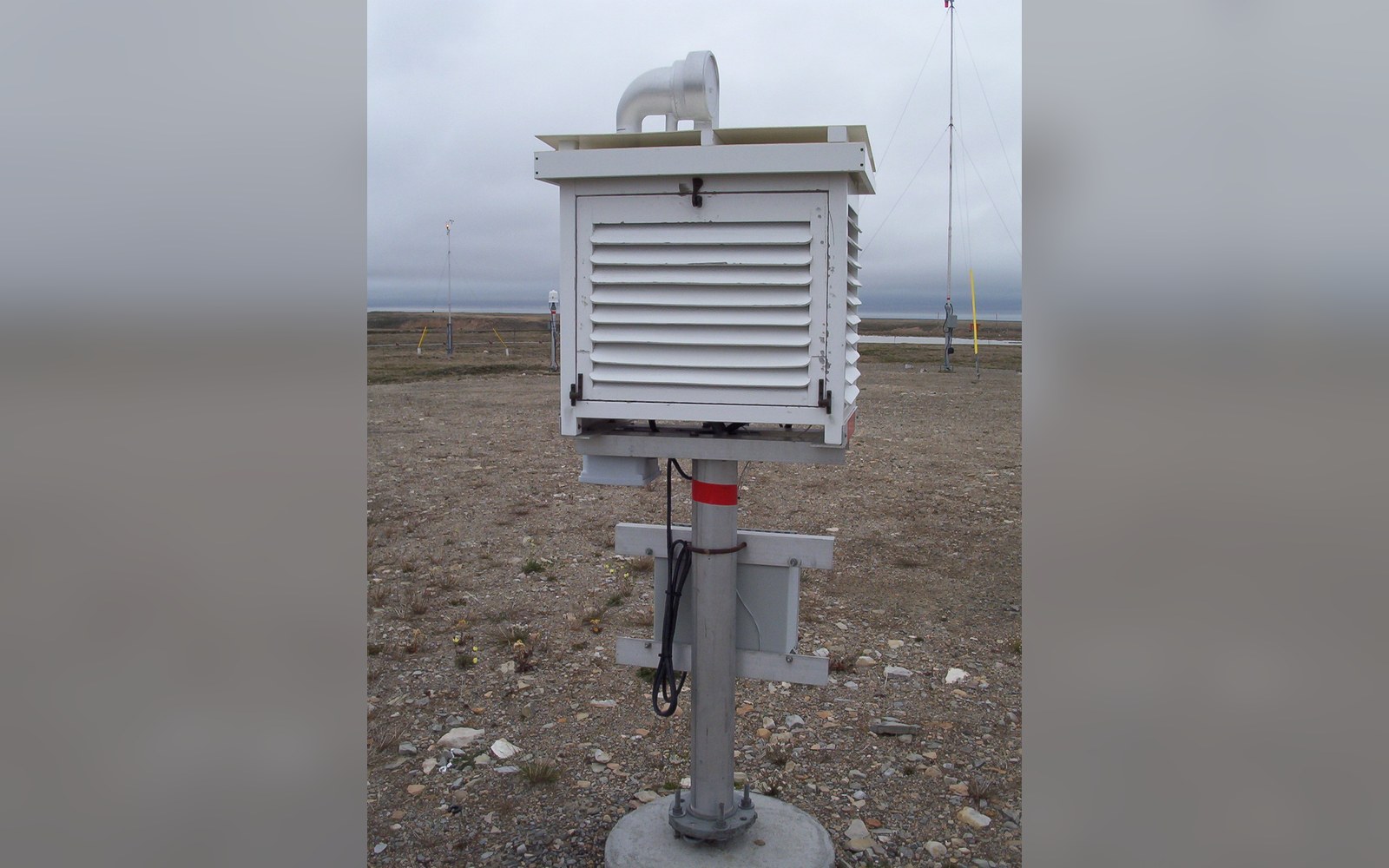
The screen is named after Thomas Stevenson ↗, a Scottish civil engineer best known professionally for designing lighthouses and best known to literature as the father of Robert Louis Stevenson. His meteorological contribution was modest in scope and enormous in consequence: he worked out, through systematic comparison, that a double-louvred wooden box painted white and raised about 1.2 metres above a grass surface would shelter a thermometer from solar radiation and precipitation while allowing the free circulation of ambient air. The goal — measuring air temperature as distinct from radiant temperature — sounds obvious. Arriving at a standardised geometry that achieved it reproducibly was not.
Before the screen existed, thermometers were mounted in all kinds of ad hoc shelters: north-facing walls, garden niches, purpose-built hutches of varying shapes and shading. Each installation biased its readings differently. A thermometer in a shallow recess caught reflected radiation from the ground; one mounted too close to a wall responded to the wall's stored heat. Stevenson's insight was to treat the problem as one of elimination: get rid of every source of heat other than the air itself. White paint reflected solar radiation rather than absorbing it. The double-louvred walls — horizontal slats angled to exclude rain and direct sun — let wind pass through without letting the instrument see the sky or the ground directly. The legs raised the box clear of ground radiation and matched a height that, with time, the World Meteorological Organization ↗ would encode in its technical guidance as the standard observation height for surface air temperature.
What standardisation actually does
A temperature reading only means something relative to other temperature readings. Two stations a hundred kilometres apart become comparable the moment they both use the same screen geometry, the same height, the same surface beneath them. Chain those stations together across continents, and you have a synoptic network — a simultaneous snapshot of the atmosphere's surface state. Without a common housing specification, that chain is broken: you cannot draw an isobar across incompatible numbers, and you cannot verify a model against observations that measure slightly different things.
The WMO's current Guide to Instruments and Methods of Observation specifies the screen's dimensions, materials, paint finish and maintenance schedule in enough detail that a replacement screen built in any member country produces readings consistent with those from any other. The screen must be painted white on all exterior surfaces. The floor must be louvred or slatted. The door must face north in the northern hemisphere, away from the sun's path, so that opening it to read the instruments does not flood the interior with direct radiation. These requirements read like bureaucracy and work like calibration.
Louvred wood, white paint, a specified height: the point is to measure air rather than sunshine, and the design has barely changed.
Wood is part of the specification because it is a poor conductor of heat. A metal screen would warm up in the sun and radiate into the interior even if its walls kept direct sunlight out. Some national services have experimented with radiation shields made of polished metal or plastic, and the WMO has evaluated them carefully, because any material change risks introducing a systematic offset — a consistent bias that could corrupt a long-term temperature record or misrepresent a model's boundary conditions. The difficulty of proving that a new design is genuinely equivalent has kept louvred painted wood as the de facto standard for most of the world's land stations, even as other meteorological instruments have been transformed beyond recognition.
Key numbers
- 1.2 mspecified height of screen floor above grass surface (WMO standard observation height for surface air temperature)
- 4 instrumentstypically: dry-bulb, wet-bulb, maximum and minimum thermometers; modern screens add a resistance thermometer or thermistor
- 1860sdecade when Thomas Stevenson developed and compared screen designs in Edinburgh
Inside a typical Stevenson screen you will find a dry-bulb thermometer, a wet-bulb thermometer (whose depression below dry-bulb gives relative humidity), a maximum thermometer that retains its highest reading until it is reset, and a minimum thermometer that leaves a marker at its coldest point. Many screens now also house a platinum resistance thermometer or a thermistor connected to a data logger, which records continuously and transmits automatically. The screen remains; the technology inside it has changed generation by generation. Automatic weather stations now outnumber manually read stations at many networks, but the housing requirement is the same, because what the screen is doing — isolating the instrument from non-atmospheric heat sources — has not changed.
Why the shape of the error matters
When forecasters and researchers talk about the quality of surface temperature data, one recurrent problem is the screen's sensitivity to its immediate surroundings. The specification calls for a grass surface beneath and around the screen, at a site away from buildings, trees, and paved areas. In practice, cities grow around weather stations, tarmac replaces grass, and the screen's neighbourhood changes. The instrument inside reads the air correctly for the air that reaches it; the difficulty is that the air reaching an urban station is now a few tenths of a degree warmer than it would have been in an open field. This is real — it is what the station is measuring — but it is different from what a rural station of the same design measures, and reconciling those two records for long-term use requires careful adjustments that are themselves the subject of ongoing research.
What the screen excludes
- Direct solar radiationdeflected by white paint and angled louvres
- Reflected ground radiationelevation on legs reduces exposure
- Rainlouvre geometry excludes precipitation while admitting air
- Stored heatwood chosen over metal as a poor thermal conductor
The screen has no electronics to fail and no firmware to update. Its failure modes are paint flaking (which increases radiation absorption), warped louvres (which reduce ventilation), and doors left ajar (which admits direct radiation). National networks inspect and repaint their screens on schedules; the WMO recommends checking at every station visit, whenever that is. The simplicity that makes the design durable is the same simplicity that makes its failure modes visible and fixable without specialist equipment.
Robert FitzRoy, who built the first operational storm warning service in Britain in the 1860s and was among the first to run a public forecast network, equipped his coastal stations with instruments but without a unified shelter standard. Stevenson's contribution arrived in the same decade and in the same spirit — the conviction that a measurement means nothing unless it is made the same way everywhere. A forecast depends on observations. Observations depend on instruments. Instruments depend on housings that keep every influence except the atmosphere itself at bay. The Stevenson screen is that housing, still painted white, still on its wooden legs, still doing one thing very well.
Elsewhere in Instruments
A thermometer in a louvred box, and everything after it. Everything in this section.
- The radiosonde ascentLongA balloon rises for around ninety minutes until the latex gives way at roughly thirty kilometres, transmitting all the way up.
- Anemometers, and Robinson's cupsMediumFour cups on a spindle turn at a rate related to wind speed — a relationship that turned out to be less simple than its inventor believed, and had to be calibrated rather than derived.
- The Buoys Nobody VisitsMediumMost of the planet is ocean, so most observation is unattended and has to survive years without maintenance.
- What satellites cannot seeMediumA satellite measures radiance, not temperature, and turning one into the other is a calculation with assumptions in it.