Sixty-four thousand people with slide rules
His estimate of what it would take to keep pace with the weather, arranged in a hall like an orchestra, is the clearest picture of what a model does.
Richardson imagined a hall full of human computers working in parallel. The image turned out to be a blueprint.
The forecast factory
Lewis Fry Richardson's six-week hand calculation of a single six-hour pressure change, published in 1922, was a proof of concept — but Richardson himself knew it could never be a working forecast service. By the time a lone mathematician finished the arithmetic, the weather it described had come and gone weeks ago. What he needed was parallelism: the same work distributed across enough hands that it could be done, roughly, in the time the atmosphere takes to evolve.
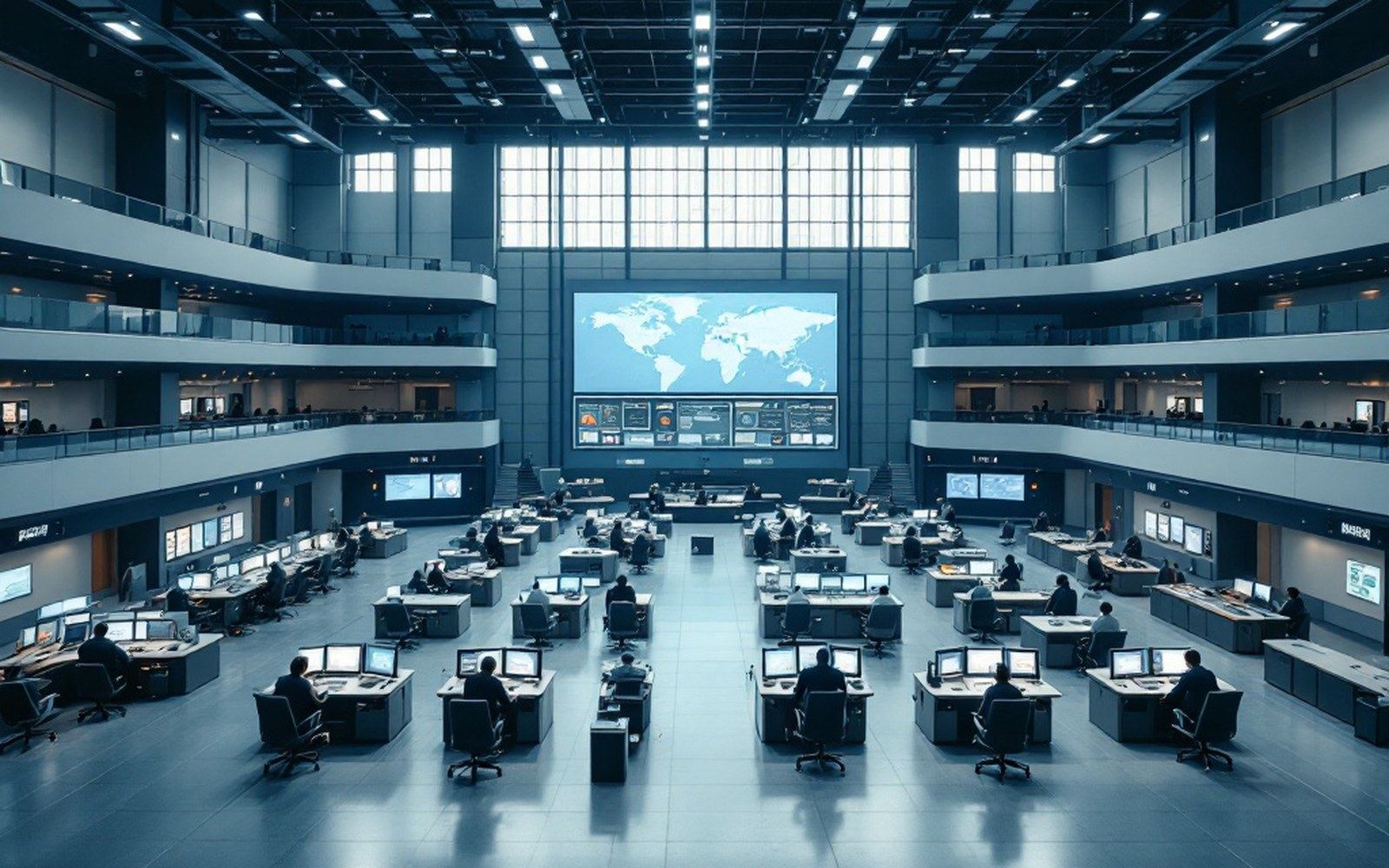
So he imagined a building. In Weather Prediction by Numerical Process, he described a vast circular hall — he called it the "forecast factory" — staffed by sixty-four thousand human computers, each responsible for a small patch of the globe, each performing one slice of the calculation and passing its result to a neighbor. Overseers in colored lighting coordinated the pace. A conductor figure at the center monitored the flow and corrected drift. The whole ensemble would, he estimated, just barely keep pace with the real atmosphere.
His estimate of what it would take to keep pace with the weather, arranged in a hall like an orchestra, is the clearest picture of what a model does.
The number sixty-four thousand was not a rhetorical flourish. It came from counting the arithmetic operations required to step the full atmosphere forward by a short interval — what would later be called a time step — and dividing by what a single trained person could reasonably do in that interval. Richardson was using the then-current picture of global weather station density to estimate how finely the globe needed to be divided. The answer was a grid, each cell about 200 kilometers across. Each cell needed a set of equations solved. Each equation needed numbers fed from neighboring cells. The parallelism was not optional; it was baked into the physics.
What the image actually describes
Strip away the hall and the slide rules, and Richardson's factory is a description of a numerical weather prediction ↗ model in almost every essential detail. The globe is divided into a grid. Each grid cell carries a set of atmospheric variables — pressure, temperature, humidity, wind — and the model steps those variables forward in time by solving equations that relate each cell to its neighbors. The human computers become processors, the colored lighting becomes a scheduler, and the conductor becomes the software that enforces mass and energy conservation across the whole domain.
When Jule Charney led the first successful machine forecast at the Institute for Advanced Study in Princeton in 1950, using ENIAC, the structure Richardson had imagined was precisely what they implemented — the grid, the time step, the boundary conditions, the marching forward through time. ENIAC ran the calculation ↗ in roughly twenty-four hours for a twenty-four-hour forecast; the human factory would have taken the same twenty-four hours if it had actually been built, on Richardson's estimate. The machine matched the pace Richardson had said would be necessary, keeping up with the atmosphere rather than trailing it by days.
Chronology
- 1922Richardson publishes Weather Prediction by Numerical Process, including the forecast factory description
- 1950Charney's team produces the first successful numerical forecast using ENIAC, with the Institute for Advanced Study team in Princeton
The European Centre for Medium-Range Weather Forecasts, based in Reading, England, now runs a global model with a horizontal resolution far finer than Richardson's 200-kilometer cells, updated multiple times daily. The number of arithmetic operations per forecast is staggering in any human-scaled terms, and yet the underlying logic has not changed: divide the atmosphere into cells, pass information between neighbors, step forward in time, repeat.
Key architecture
- The forecast factoryRichardson's thought experiment: 64,000 human computers in a spherical hall, each solving equations for one atmospheric cell
- Time stepthe short interval by which the model advances the atmosphere in each iteration
- Grid cellone unit of the divided globe; Richardson's cells were roughly 200 km across; modern operational models are far finer
What Richardson gave forecasting was not just a failed first attempt. He gave it a shape — a way of thinking about the problem that made it legible to everyone who came after. The sixty-four thousand people never filled the hall, but every numerical model ever run has been, in its architecture, that hall. The slide rules became transistors; the conductors became algorithms; the colored lights became scheduling code. The geometry stayed exactly as he drew it.
Elsewhere in Arithmetic
A forecast you calculate rather than guess. Everything in this section.
- Six Weeks of Arithmetic for Six Hours of WeatherLongRichardson calculated a single six-hour forecast by hand in 1922.
- Bjerknes states the problemLongBefore anyone could calculate a forecast somebody had to say precisely what calculating one would mean: a set of equations, a set of initial measurements, and no meteorology in between.
- Why it came out wrongLongThe arithmetic was sound; the initial data was not smoothed, so the calculation amplified noise that was never in the atmosphere.
- What a Forecast Actually IsShortA probability dressed as certainty, derived from a snapshot that no one quite gets right.