Bjerknes states the problem
Before anyone could calculate a forecast somebody had to say precisely what calculating one would mean: a set of equations, a set of initial measurements, and no meteorology in between.
The problem with weather, precisely stated
For most of the nineteenth century, meteorology was a science of patterns. Observers watched the sky, recorded pressures and temperatures, drew charts of what had already happened, and looked for rules of thumb — a falling glass usually meant rain; a cone raised at the harbour meant a gale might be coming. Robert FitzRoy, who built the first official storm-warning service, worked entirely this way: the warnings were brilliant, but they rested on experience, not equations. There was no proof that the atmosphere had to behave as it did; there was only evidence that it usually did.
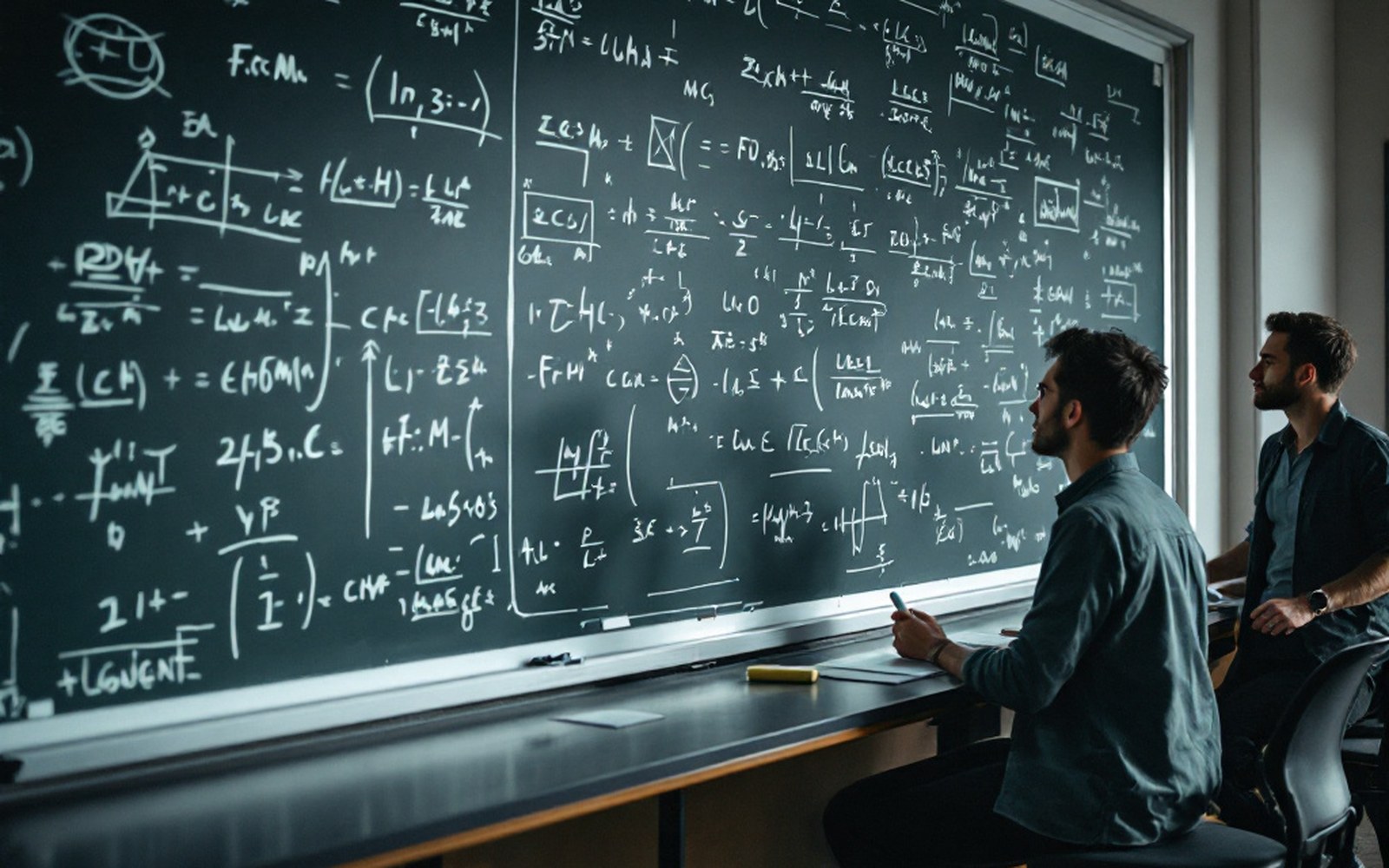
What nobody had yet done was frame the problem as a mathematical one. Not "what does the weather look like?" but "what are the physical laws that govern it, what measurements would you need to feed them, and what would come out the other end?" That step — which sounds administrative but is really foundational — was taken by Vilhelm Bjerknes.
Bjerknes was a Norwegian physicist who had worked on fluid mechanics and electromagnetic theory before turning his attention to the atmosphere and ocean. In 1904 he published a paper — the one that still gets cited as the hinge — setting out what he called the "program" for scientific weather forecasting. His argument was, in retrospect, so clear that it looks inevitable: the atmosphere is a physical fluid; physical fluids obey known equations; if you know the state of the fluid at one moment, the equations should, in principle, tell you the state at a later moment. Forecasting was therefore a problem in applied mathematics, not in pattern-matching.
The equations and the initial state
Bjerknes identified two requirements. The first was a complete set of governing equations — the physical laws relating pressure, temperature, density, humidity, and wind velocity across the atmosphere. These were not new in themselves; the Navier-Stokes equations for fluid motion had existed for decades, and thermodynamics was well established. What was new was insisting that they be applied together, systematically, to the real atmosphere rather than to simplified theoretical cases.

The second requirement was what he called the initial state: a description, precise enough to be mathematical, of the atmosphere at a given moment. Pressure everywhere, temperature everywhere, wind everywhere, moisture everywhere — all at the same time. Without a complete initial state, you could not run the equations forward. The forecast would not be wrong in a correctable way; it simply would not exist. This is data assimilation in embryo, sixty years before the term was in common use.
Together, these two requirements defined the structure of every numerical weather model that would follow. The 1904 paper is not a solution — Bjerknes himself did not compute a forecast from it — but it is the clearest possible statement of what a solution would require. Bjerknes's 1904 paper ↗ is cited in virtually every historical account of numerical prediction for this reason.
What the paper also made plain, by implication, was the scale of the work. The equations were nonlinear; they coupled the variables in ways that made closed-form solutions impossible for any realistic case. Progress would require not elegance but computation, and computation on a scale the world could not yet imagine. Lewis Fry Richardson read the paper, understood this perfectly, and in the years around the First World War actually attempted the first numerical calculation of a forecast by hand — a project so vast that it took him six weeks to compute a single six-hour forecast. The result was numerically wrong, but the method was Bjerknes's.
Bergen, and the next generation
Bjerknes moved in 1917 to Bergen, where he founded what became the Bergen Geophysical Institute. There, with a team that included his son Jacob Bjerknes and colleagues such as Halvor Solberg and Tor Bergeron, he built something that looked different from the 1904 programme but grew directly out of it: a physical theory of fronts and air masses. The Bergen School ↗, as it came to be called, gave operational forecasters the concept of the front — a boundary between air masses of different temperature and humidity — and with it a way of reading a synoptic chart that was far more powerful than anything available before. Jacob Bjerknes published the foundational account of the extratropical cyclone in 1919, describing the structure of low-pressure systems that still appears, in essentially the same form, in textbooks today.

This work was partly a pragmatic detour. Computing the full set of equations was not possible in 1917 without machinery that did not exist; Bergen produced something that forecasters could actually use. But it was a detour taken in full knowledge of where the road was supposed to lead. Vilhelm Bjerknes never stopped believing that the 1904 programme was the destination.
The two requirements
- The governing equationsphysical laws (pressure, temperature, density, humidity, wind) applied together across the whole atmosphere
- The initial statea simultaneous numerical description of the atmosphere everywhere, without which equations cannot run forward
The machinery arrived, eventually. Jule Charney, working with colleagues at the Institute for Advanced Study in Princeton, used ENIAC in 1950 to run the first successful numerical forecast. The equations were the atmosphere's equations; the initial state was real observational data; the arithmetic was done by a machine. The structure was precisely what Bjerknes had specified forty-six years earlier. Charney acknowledged the debt explicitly, as did Richardson before him, as does the World Meteorological Organization in its own account of the history of the field.
Chronology
- 1904Bjerknes publishes the "programme" paper defining numerical weather prediction as a problem
- 1917Bjerknes moves to Bergen; the Bergen Geophysical Institute is founded
- 1919Jacob Bjerknes publishes the theory of the extratropical cyclone and fronts
- 1922Richardson publishes his hand-calculated six-hour forecast
- 1950Charney and colleagues use ENIAC to produce the first successful numerical forecast
The European Centre for Medium-Range Weather Forecasts — ECMWF, based in Reading, England — now runs one of the most scrutinised numerical prediction systems on the planet. Its models solve, at every time step, equations that Bjerknes would recognise. The initial state is assembled from satellites, radiosondes, buoys, and surface stations through data assimilation schemes of extraordinary complexity. The thing being computed is still, at root, the same thing the 1904 paper described: take the state of the atmosphere now, apply the laws of physics, and produce the state a little later.
What Bjerknes supplied was not a technique but a definition. He said, in a paper short enough to read in an hour, that weather forecasting was a determinate mathematical problem — which meant it had a right answer, and meant that getting closer to that answer was a matter of better equations, better observations, and more computation. Every improvement since has been exactly that.
Elsewhere in Arithmetic
A forecast you calculate rather than guess. Everything in this section.
- Six Weeks of Arithmetic for Six Hours of WeatherLongRichardson calculated a single six-hour forecast by hand in 1922.
- Why it came out wrongLongThe arithmetic was sound; the initial data was not smoothed, so the calculation amplified noise that was never in the atmosphere.
- Sixty-four thousand people with slide rulesMediumHis estimate of what it would take to keep pace with the weather, arranged in a hall like an orchestra, is the clearest picture of what a model does.
- What a Forecast Actually IsShortA probability dressed as certainty, derived from a snapshot that no one quite gets right.