The People on Shift
A forecast office runs continuously, and the handover between shifts is where judgement is actually transferred from one person to the next.
The forecast office never closes, and the moment one team hands it to the next is where experience actually lives.
What the room looks like
Walk into a modern forecast office — the Met Office in Exeter, say, or any of the National Weather Service offices distributed across the United States — and the first thing you notice is that it looks less like a laboratory and more like an air-traffic control centre. Screens cover the workstations: radar loops, satellite imagery, model output, upper-air charts. Someone is always talking on a phone. Someone else is annotating a chart. The shift runs in blocks, typically six to twelve hours, and the facility produces forecasts continuously around the clock, every day of the year.
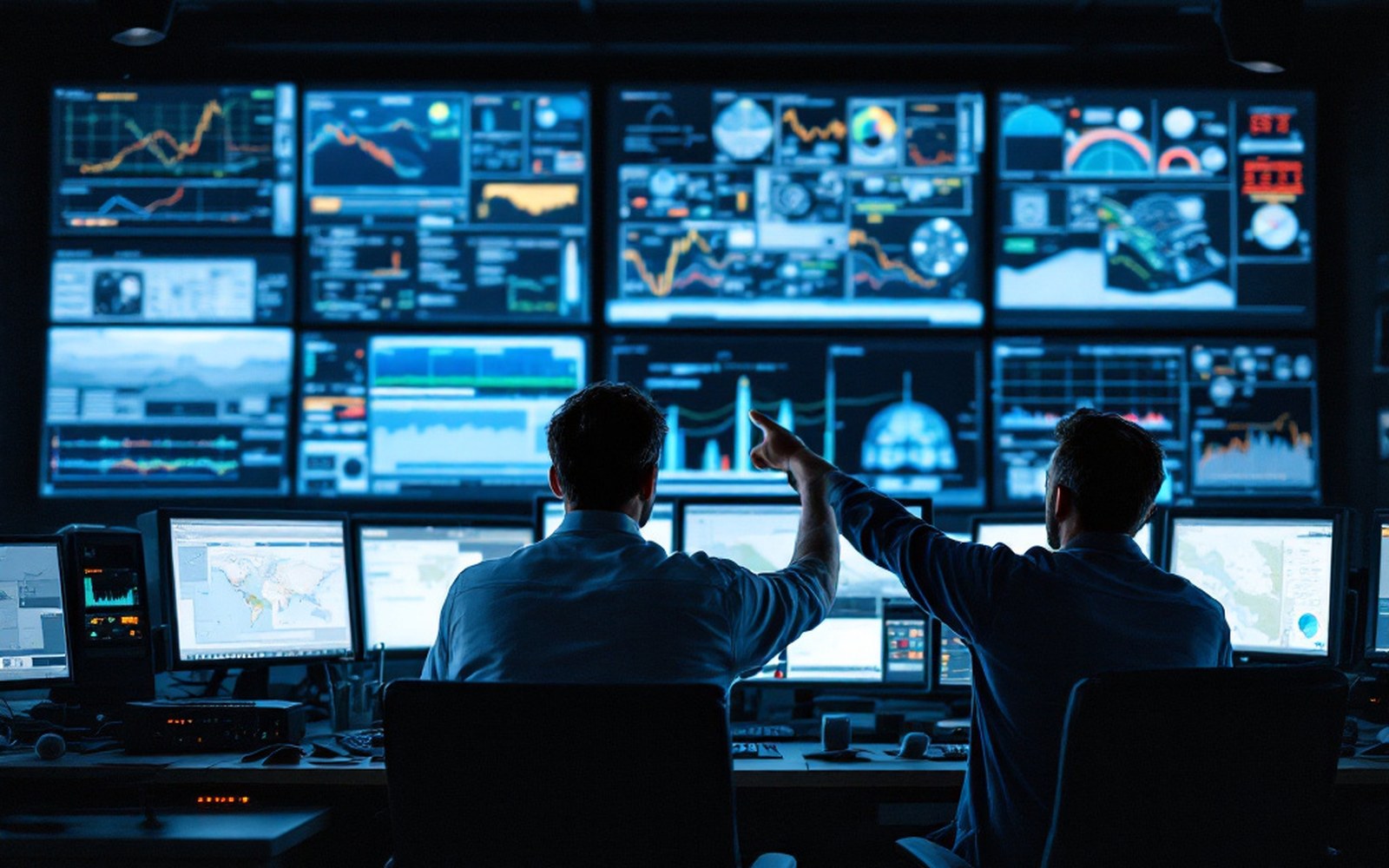
The people doing this work are operational meteorologists, and the job is distinct from research. A researcher can sit with a problem for months. An operational forecaster has a deadline that comes around every few hours whether the atmosphere is cooperative or not.
The handover
The handover — the briefing that transfers responsibility from the outgoing shift to the incoming one — is the most consequential few minutes in the building. The departing forecaster does not simply leave notes and go home. They walk their replacement through the current analysis: where the fronts are sitting, which model runs have diverged from each other and why, which areas are showing convective potential that the models may be underweighting. The incoming forecaster asks questions. Discrepancies get flagged. Uncertainty, crucially, gets named out loud.

This verbal transfer carries things that documentation cannot easily hold. A forecaster who has been watching a particular pressure system for eight hours has an intuition about its behaviour that is real but hard to write down. The outgoing shift knows whether the overnight radiosonde ascents came back with the humidity profile that was expected, or whether there is a dry intrusion at mid-levels that changes the instability calculation. That kind of contextual knowledge, passed person to person, is a significant part of what makes the final forecast better than the raw model output would be alone.
Judgement versus output
Numerical models are now so capable that it is tempting to think of the forecaster as someone who reads a printout and distributes it. That is not what happens. The ECMWF ensemble, which runs the model many times from slightly different starting points, gives a probability distribution rather than a single answer — and translating that distribution into a plain-language forecast for the public, a categorical warning for emergency managers, or a specific ceiling-and-visibility number for aviation is a judgement call that requires meteorological reasoning, not just computation. When the ensemble members disagree badly, the forecaster has to decide which cluster is more physically plausible, and why, and what to tell people as a result.
A forecast office runs continuously, and the handover between shifts is where judgement is actually transferred from one person to the next.
That decision sits with the person on shift. It is not produced automatically, and it is not reviewed by a committee. The World Meteorological Organization's guidelines on forecast verification ↗ require that forecasts be scored against what actually happens, and those verification statistics accumulate office by office and shift by shift — which means the quality of individual judgements eventually shows up in the numbers, even if no single forecast is marked right or wrong in the moment it is issued.
How the work is structured
- Operational forecasterproduces forecasts on a schedule, as opposed to research meteorologists who work on longer timescales
- Shift handoververbal briefing in which the outgoing team transfers situational awareness to the incoming team
- Ensemblemodel run many times from varied starting points, producing a range of outcomes rather than one answer
- Verificationsystematic scoring of forecasts against what actually occurred
The room, then, is where probability becomes a decision, where model skill meets local knowledge, and where two meteorologists face each other across a workstation and one of them says: here is what I think is happening, here is what I am not sure about, and now it is yours. That sentence — repeated in forecast offices worldwide, in every time zone, hundreds of times a day — is where the science of Robert FitzRoy and Vilhelm Bjerknes ↗ becomes the thing on your phone.
Elsewhere in The room
Richardson's hall is now a room of screens. Everything in this sectionconcerns what happens in that room, from the first machine forecasts to the daily running of a model.
- ENIAC, and the first machine forecastLongIn 1950 a machine reproduced in about a day the kind of calculation Richardson had done by hand in six weeks, and the result was good enough to prove the method rather than the weather.
- How a model is actually runLongRunning a numerical weather model is not pressing a button and waiting.
- Somebody still draws the isobarsMediumThe synoptic chart looks like it predates the computer.
- Getting the observations inMediumBefore the model can run, it needs to know where the atmosphere is right now — and that is harder than it sounds.